A People finance report is an ordinary People report that also pulls each person's giving and transaction data alongside their contact details. You build it in the People report area by adding finance criteria to narrow the list, then choosing finance fields to show totals such as how much each person has given, how many transactions they have, and when they first and last gave. It is the general way to report on money against people, and it is the tool many organisations use for year-end giving checks and receipting preparation.
Two other articles cover related ground. Finance Reports are the reports that live in the finance area itself, grouped by account code and batch rather than by person. Lapsed Donors is one specific People finance report, built from two date criteria to find people who used to give and have stopped. This article is the general feature that both of those build on.
Before you start
Role Permissions
To build a People finance report you need:
- Run reports
- One of the finance reporting permissions: Manage, Read and report on transactions, Read and Report on Transactions, or View others on API, profile, and reports only. The finance criteria and finance fields only appear in the People report area when your role includes one of these. Being a member of a cluster does not grant finance access on its own.
To include the Giving Number field you also need Edit Giving Numbers for people.
For what each permission means and how an administrator turns it on, see About Permission Roles and Finance Permissions.
The finance reporting permission you have affects whose giving you see. Manage, Read and report on transactions and Read and Report on Transactions report across everyone. View others on API, profile, and reports only is scoped to the people in the groups you administer, so the report returns finance data for those people.
How a People finance report works
A People finance report has two moving parts:
- Finance criteria narrow which people appear, based on their giving. For example, people who gave to a particular account code, in a date range, or above an amount.
- Finance fields are the columns you add to the output, such as each person's total given and their latest transaction date.
You can use finance criteria without finance fields, or finance fields without finance criteria. Most reports use both: criteria to select the right people, fields to show their numbers.
Building the report
Step 1: Open the People report area
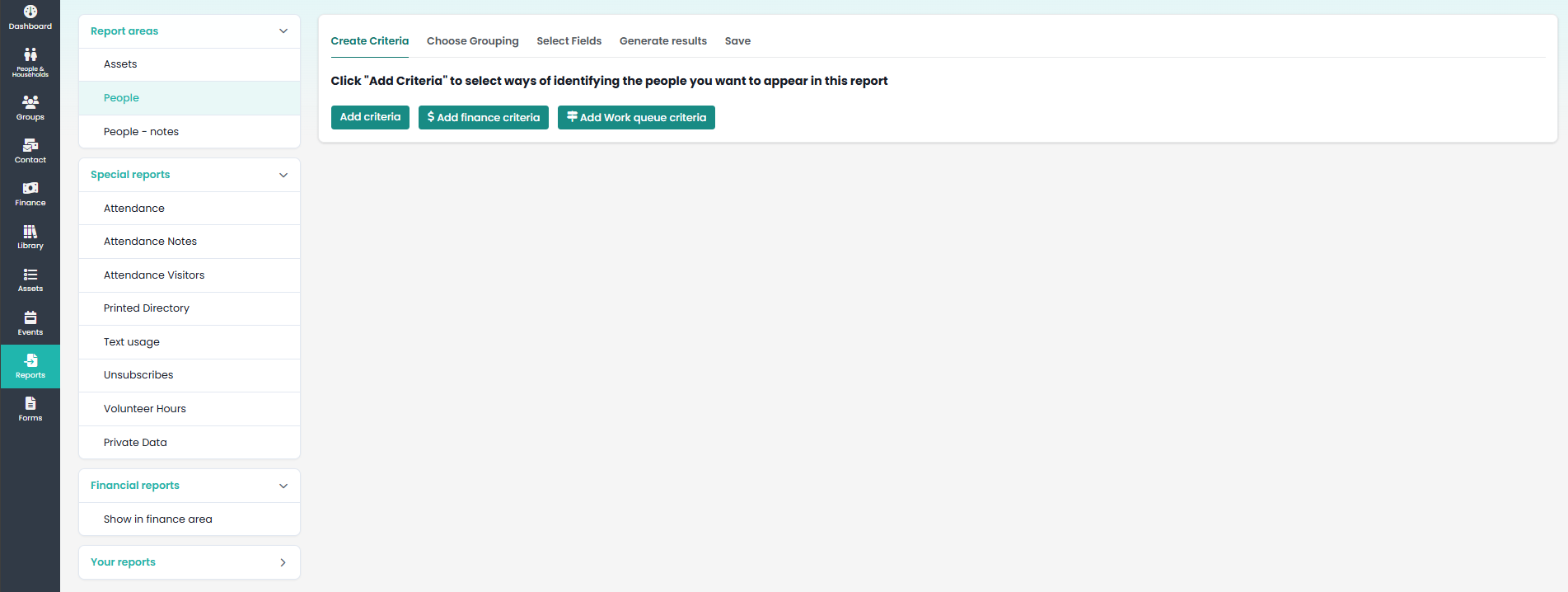
Click Reports on the main menu bar on the left. Under Report areas click People. The report opens on the Create Criteria tab, with the tabs Create Criteria, Choose Grouping, Select Fields, Generate results and Save across the top.
The same page lists Financial reports with a Show in finance area link. That link takes you to the separate finance-area reports, which are a different feature. Stay in the People area for a People finance report.
Step 2: Add finance criteria
On the Create Criteria tab, click Add finance criteria. A finance criterion row appears with a field selector.
- Choose a finance field from the list, for example Transaction date.
- Choose how to match it, such as equals, earlier than, later than, or not set.
- Enter the value. For dates you can enter a Specific date or switch to Preset date ranges to use a rolling range such as This financial year.
Click Add finance criteria again to add more rows, and use the or toggle on a row to combine it with the previous row as an alternative rather than an additional condition. For a giving date range, add Transaction date later than your start date and a second Transaction date earlier than your end date.

The finance criteria you can add include:
| Finance criterion | What it filters on |
|---|---|
| Transaction date | The date of a person's transactions. Combine an earlier-than and a later-than to make a date range. |
| Total amount | Each person's total giving in the reported period, so you can focus on donors above or below an amount. |
| Total amount (all time) | Each person's lifetime total, regardless of any date criteria on the report. |
| Total transactions | How many transactions a person has, for example more than one gift rather than a single one-off. |
| Account code | Giving posted to a particular account code. |
| Campaign name and Campaign type | Giving to a particular campaign or appeal. |
| Tax rebatable? | Whether the giving is receiptable / tax rebatable, useful for year-end receipting checks. |
| Giving number | People who have a giving number assigned. |
| No transactions | People with no giving in the range you set. Pairing this with a date criterion is how the Lapsed Donors report is built. |
Step 3: Choose the finance fields to display
Open the Select Fields tab and tick the fields you want in the output. The person fields sit at the top; scroll down to the Finance section for the finance fields. Choose the common choices under Person and Contact Data. Then choose the Finance options, such as Giving Number, and finance totals such as Total Amount by criteria and Total Trans by criteria.
 {height="" width=""}
Many finance fields come in two versions, and the difference matters:
| Field ending | What it counts |
|---|---|
| by criteria | Only the transactions that match this report's finance criteria. A Total Amount by criteria with a date range shows the total given in that range. |
| all activity | The person's whole giving history, ignoring the report's finance criteria. A Total Amount all activity shows the lifetime total even when the report is filtered to one year. |
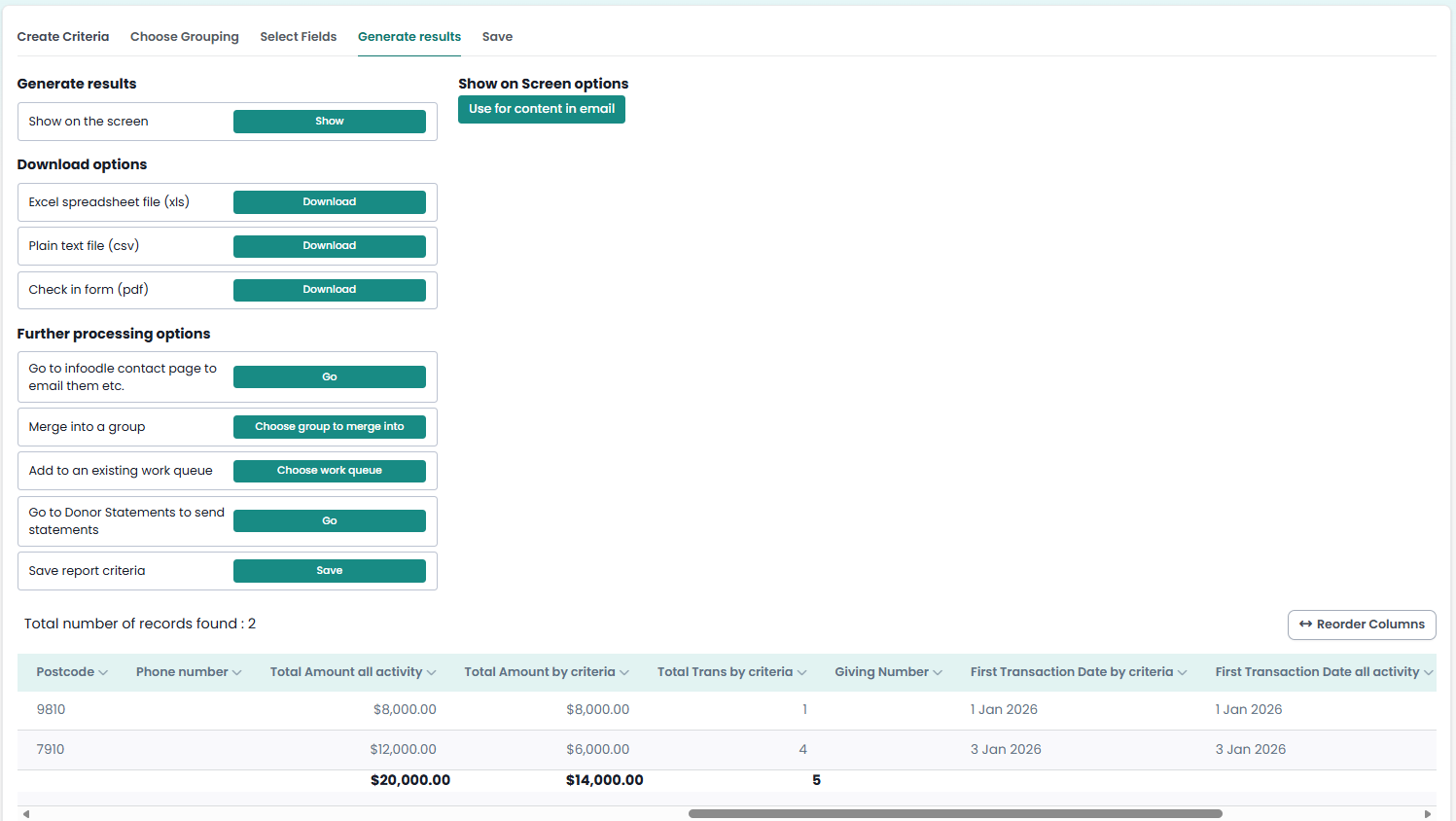
So a person can show a small Total Amount by criteria for the selected year next to a much larger Total Amount all activity for their lifetime. Pick the version that answers your question.
With no finance criteria set, a by-criteria total equals the matching all-activity total, because there is nothing to narrow it down. The two columns only diverge once a finance criterion is in place to filter the by-criteria figure.
Step 4: Generate the results
Open the Generate results tab.
- Click Show to see the results on screen, including your finance columns.
- Use the Download options to export to Excel (xls), plain text (csv), or a check-in form (pdf).
- The further processing options let you go to the contact page to email the people, merge them into a group, add them to a work queue, or go to Donor Statements.
Step 5: Save the report to reuse it
Open the Save tab, enter a report name, choose who can see it, and click Save. You can also tick the option to make the report available as an advanced search filter. A saved report keeps its finance criteria and fields, so you can rerun the same giving report each year or each quarter.
What counts as giving in the report
The finance criteria and totals read the transactions recorded against each person in infoodle. A person's Total Amount is the sum of their transaction amounts, and the Transaction date used by the date criteria is the date the transaction was recorded against. Because the numbers come straight from recorded transactions, the report reflects the giving that has been entered and dated. If you scope the report with Account code or Campaign name, only transactions matching that scope count toward the by-criteria totals.
In-kind gifts are recorded as transactions too, so they count toward the cash totals such as Total Amount by criteria and Total Amount all activity alongside cash gifts. Separate inkind fields let you report the in-kind portion on its own.
The Total Amount fields include in-kind gifts in the figure. Before you use a total for year-end receipting or to report receiptable cash, scope in-kind gifts out with a criterion such as Account code or Tax rebatable?, or read the in-kind portion from the inkind fields, so the cash figure you rely on is the one you intend.
Common questions
What is the difference between People Finance Reports and Finance Reports?
A People finance report is a People report with money added, so the result is a list of people with their giving. Finance Reports live in the finance area and summarise transactions by account code, batch, and campaign rather than by person. Use a People finance report when you want to see who gave; use Finance Reports when you want to reconcile the money itself.
Why can I not see the finance criteria or finance fields?
They only appear in the People report area when your role includes one of the finance reporting permissions listed in Before you start. Ask an administrator to check your role under Settings if the finance options are missing.
Why do two total columns show different numbers for the same person?
The by criteria fields count only the transactions matching this report's finance criteria, while the all activity fields count the person's entire giving history. A person filtered to one year will show a smaller by-criteria total than their all-activity lifetime total. If you have not set any finance criteria, the two columns will instead read the same, because there is nothing narrowing the by-criteria figure.
Can I email or group the people the report returns?
Yes. From the Generate results tab you can go to the contact page to email them, merge them into a group, or add them to a work queue, provided your role includes the matching contact permissions.
Next steps
Save the report so you can rerun it at year end, then use the Select Fields finance columns to check that each person's totals and giving numbers are correct before you run receipting.