Deleting a person permanently removes their record from infoodle. The contact, their household links, and personal details are taken out of the active database. Their financial transactions stay in place for audit purposes, but the link back to the person is severed, so they no longer appear in reports, workflows, or contact searches.
Deletion is a one way step. For most cases, archiving is the better choice: it lifts the person out of day-to-day lists while keeping the full history and the ability to bring them back later. Use delete only when you genuinely need the record gone, for example to honour a privacy request to erase personal data.
Before you start
Role Permissions
To delete a person you will need:
- Can delete people from the database
- Able to archive people
- Edit any person and household contact details (or Edit my household and contact details if the person sits in your own household)
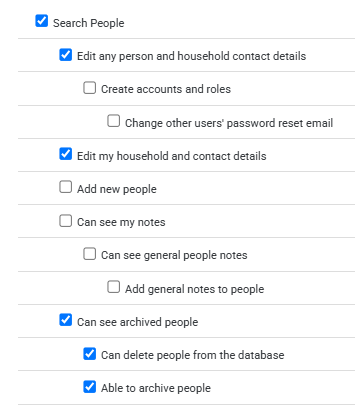
For an explanation of every role permission and how to assign them, see People role permissions.
You will also need to know two things before you start:
- Whether the person has any financial transactions. If they do, infoodle will ask you to type OK to confirm you accept losing the link from those transactions back to the person.
- Whether archiving would do the job instead. See the comparison below.
Delete or archive?
For most situations, archive the person rather than delete them. Archiving removes the person from your active lists and from your billing count, but keeps the full record so you can search archived contacts or restore the person later.
| Action | What it does | When to use it |
|---|---|---|
| Archive | Hides the person from active lists and reports. Their history, notes, group membership, and transactions stay in place and linked to them. The person no longer counts toward your billing tier. Reversible. | The person has left, moved on, or is no longer active, but you may want to reach them again or run historic reports. This is the safer default. |
| Delete | Permanently removes the person record. Transactions and receipts remain in the database for audit, but the person who owned them is gone, so they no longer appear in any report or search. Not reversible from the user interface. | You need the personal record erased, for example a privacy request, or a duplicate that must be removed cleanly. |
For the archive step on its own, see Archiving a Person. To archive several people at once, see Bulk Archiving.
Delete a person
You delete a person from their profile page, through the same dialog used for archiving. infoodle requires the person to be archived first, then offers Delete as an additional step in the same save.
- Click or hover on People & Households on the main menu bar on the left, then click Show all, and find the person you want to delete. Open their profile.

- Click the More profile functions cog at the top left of the profile card, next to the contact name. The cog opens a menu of profile actions.
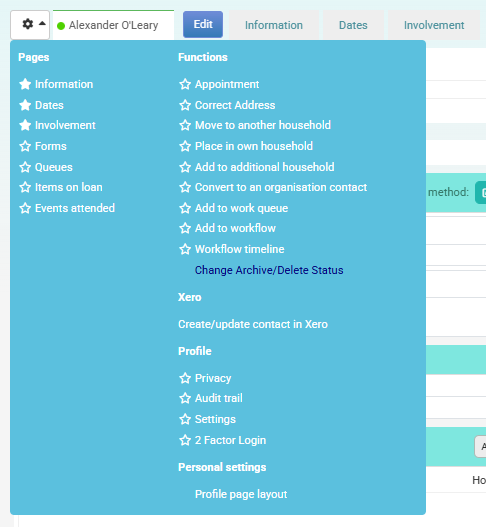
- Click Change Archive/Delete Status. The Change Archive Status dialog opens.
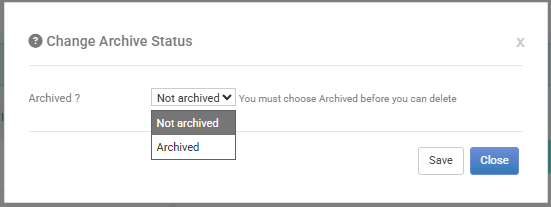
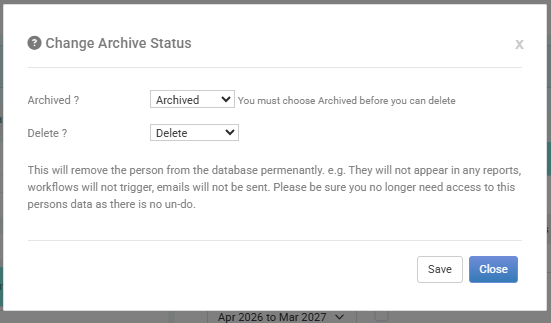
- In the Archived ? dropdown, choose Archived. A new Delete ? dropdown appears below. This two-step ordering is required: infoodle will not let you delete a person who is not first marked Archived.
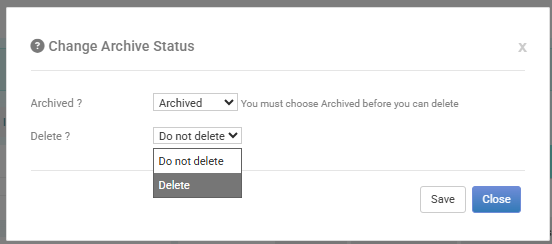
- In the Delete ? dropdown, choose Delete. A warning paragraph appears explaining that the person will be removed permanently and that there is no undo.
-
If the person has financial transactions, infoodle shows an extra Type OK to confirm field. Type the two letters OK in that field. The Save button stays inactive until you do.
-
Click Save. The dialog closes and the profile is cleared from view. The person no longer appears in People searches.
What deletion changes and what it keeps
Deletion is permanent through the user interface. There is no undo button. Use archiving if there is any chance you will want the person back.
Deleting a person removes less than it might look like. The table below shows what changes and what is kept.
| What happens | Details |
|---|---|
| Removed from active use | The person's name, contact details, and login are taken out of the active database. This is what makes them disappear from searches, reports, and the directory. |
| Kept as a backup copy | A full copy of the person's core details (name, gender, date of birth, salutation, stored login information) is kept indefinitely behind the scenes before the active record is removed. It is not reachable anywhere in the product. |
| Stays linked, but hidden from view | Group memberships, notes, dates, involvement records, personal files, change history, form entries, and workflow history are not removed. They stay linked to the deleted person behind the scenes, but stop appearing anywhere in infoodle because those views work from the active person record. |
This distinction matters if you are responding to a GDPR or privacy erasure request: the person's data is no longer visible through the product, but some of it is still held behind the scenes.
Financial transactions follow the same pattern. They stay in your site with the link back to the person removed, so they no longer appear in that person's own transaction list or in per-person donor reports. They still count in aggregate and batch finance reports, and they remain attached to any receipts already issued.
infoodle does not keep a record of who deleted a person, or when. There is no audit log entry for this action, only the backup copy described above. If your organisation needs a record of who carried out a deletion and when it happened, for compliance or governance reasons, keep that record yourself, outside infoodle, at the time you do the deletion.
What you cannot delete
- Yourself. You cannot delete the account you are logged in as.
- A person you do not have access to. If the person sits outside the people you are allowed to see, for example because of cluster restrictions, the Change Archive/Delete Status item will not be available on their profile.
- A person you cannot edit. If you only have Edit my household and contact details, you can act on your own household but not on anyone else. The Able to archive people permission is also required before the menu item appears at all.
- The required permissions are missing. Without Can delete people from the database, the Delete option in the dialog is hidden and infoodle shows the message You do not have permission in your role to delete people.
Common questions
Can I undo a deletion?
Not from the user interface. A backup copy of the person's core details is kept behind the scenes after deletion, but there is no Restore button to bring it back yourself. If you need a deleted person back, contact infoodle support and explain the situation. For anything you might change your mind about, archive instead of delete.
What happens to their financial transactions and receipts?
The transactions and receipts stay in your site. The link from each transaction back to the person is severed, so the person no longer appears in donor reports or in their own transaction list. Receipts already issued and sent stay as-is. Aggregate and batch finance reports continue to include the amounts.
One caveat: if you re-print or reissue a receipt after the person has been deleted, the donor name field may appear blank, because the receipt template draws the name through the link that has just been removed.
Why does infoodle ask me to type OK?
The Type OK to confirm field appears only when the person has financial transactions linked to them. It is a deliberate friction step: by typing OK you are confirming that you understand the transactions will lose their link to this person and will no longer appear in donor reports or in their statement. The field accepts only two characters, so type exactly the letters O and K in uppercase.
What about a GDPR or privacy "right to be forgotten" request?
Delete is the action that matches a request to erase a person's identifiable record. After deletion the person's name, contact details, notes, and personal information no longer appear anywhere in the product.
Two things to be aware of when responding to an erasure request:
- A backup copy of the person's core details (name, date of birth, gender, salutation, stored login information) is kept indefinitely behind the scenes. It is no longer reachable anywhere in infoodle, but it still exists. If the erasure request requires this backup copy to be removed too, raise it with infoodle support.
- Group memberships, notes, dates, involvement records, personal files, change history, and workflow history are not actively deleted. They stay linked to the deleted person behind the scenes. They stop appearing anywhere in the product, but they are not erased. If full erasure of this information is required, raise it with infoodle support as well.
Are there retention rules I should think about before deleting a donor?
Yes. NZ Inland Revenue donation receipts and UK Gift Aid / GASDS records require donor identification to be retained for a defined period (typically seven years in New Zealand and six years for UK Gift Aid). Deleting a donor inside that retention window can put your charity offside with the tax regulator, even when a privacy or erasure request has been received. The standard guidance is to consult your accountant or tax adviser before deleting a donor record, and to archive rather than delete in the meantime.
What happens to their group memberships?
The deleted person disappears from group member lists in the product, because those lists are built from the active person record. Behind the scenes, the membership itself is not removed, it stays linked to the deleted person. The group itself and its history stay in place. Other members are unaffected.
What happens to workflows the person was in?
Workflows do not run for a deleted person, and the person no longer appears in any workflow lists or timelines. The workflow's history is not deleted, it is simply skipped because there is no active person left for it to run against.
Is there a bulk-delete option?
No. Deletion is one person at a time, through the Change Archive Status dialog on each profile. For removing many people from active use at once, see Bulk Archiving. If you need a large number of records hard-deleted in one operation, raise it with infoodle support.
What about a deceased person?
For someone who has passed away, deletion is usually the wrong tool. The standard process is to mark the profile so they no longer receive contact while keeping the record for ongoing receipting and historical reporting. See Processing a Deceased Person Profile.
Next steps
Once you have removed a person you no longer need, take a quick look at People & Households → Advanced Search to confirm they no longer appear, and review your archived contacts for anyone else who could be cleared up.