Hibernation and expiry let you pause a group while keeping its history.
Hibernation keeps the group in infoodle but stops all membership changes. Expiry also hides the group from message pick‑lists, removing it from everyday use. Both states can be reversed at any time.
Choose the state by asking: “Do I still need to message this group?”
- If yes (season break, paused small group, course between intakes), use hibernation.
- If no (last year’s event roster, a class that has fully finished), use expiry.
Each state is set by a date. The group enters the state on that date and reactivates when you clear or move the date forward. The same dates apply to all sub‑groups, so a parent group on break takes its whole tree with it.
Before you start
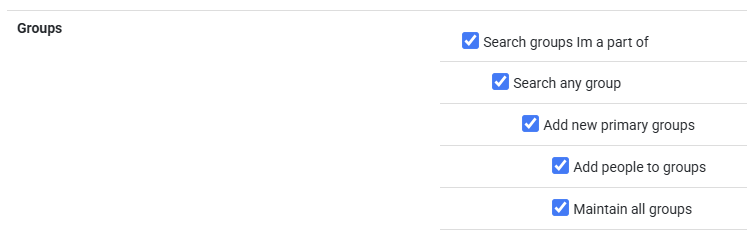
Role Permissions
Either:
- Administrator of the group you want to hibernate or expire, or
- Maintain all groups
The bulk Administration controls (further down this article) need an extra permission:
- Update System information
To find a hibernated or expired group via the sidebar filters, you also need Search any group. Group Administrators can still reach their own hibernated or expired groups via My Groups or the Show all groups button on the Groups page.
For an explanation of these and other role permissions, see People role permissions.
Step 1: Open the group
You can find the group by clicking or hovering on Groups on the main menu bar on the left, then clicking the group name.
If you do not see the group, click Show all groups at the top of the list to include hibernated and expired groups.

Step 2: Open the edit form
Click the Edit button in the group's details panel.

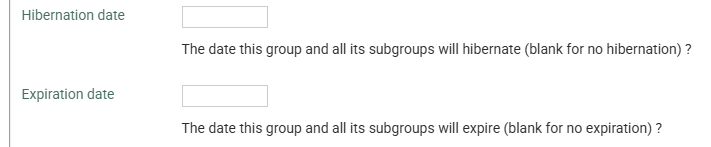
The form shows every setting for the group, including the Hibernation date and Expiration date under the identification section.
Step 3: Set the hibernation or expiration date
The date you save is the day the group switches into hibernation or expiry. Clear the date, or change it to a day after today, to make the group active again.
Click the date field to open the calendar. Pick a date from the calendar so it saves correctly. Then click Save. The group will show as hibernated or expired from the date you chose.
- Set it today to hibernate or expire the group straight away.
- Pick a future date to schedule the change. The group stays active until that day.
- Leave it blank to keep the group active.
If the group is a sub‑group, you’ll see a note showing the parent group’s date (for example: “Parent group ‘Choir’ hibernates 15‑Mar‑2027…”). This is just a warning. It’s best to keep the sub‑group’s date on or before the parent’s so it pauses at the same time.
If the group has sub‑groups, saving the date will also update all of them. Any stricter dates already set on the children stay in place until you change the parent’s date again — then all children are updated to match. If you want the children to keep their own dates, set the parent’s date last.
Step 4: Confirm the change in the Groups list
Open the Groups page. The full list excludes hibernated and expired groups by default. To see them:
- Click Show all groups at the top of the Groups page to bring back the full list including hibernated and expired groups in one view.

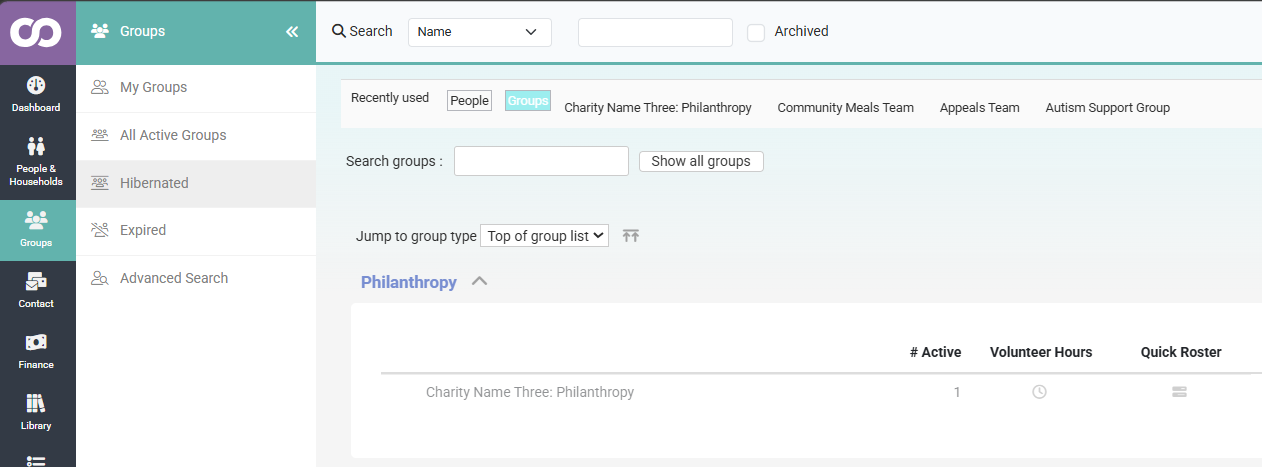
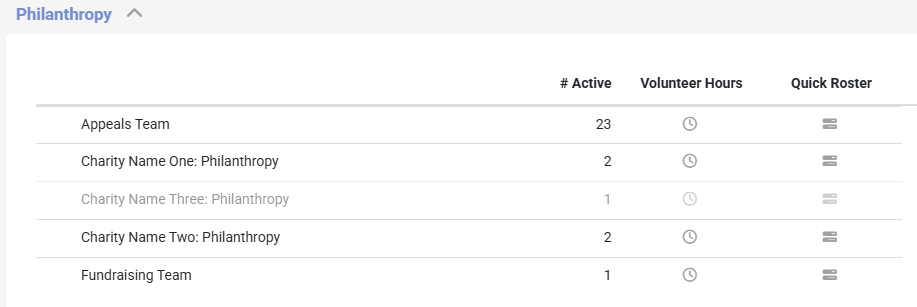
- In the left sidebar under Groups, click Hibernated to see only hibernated groups. Their names appear faded.
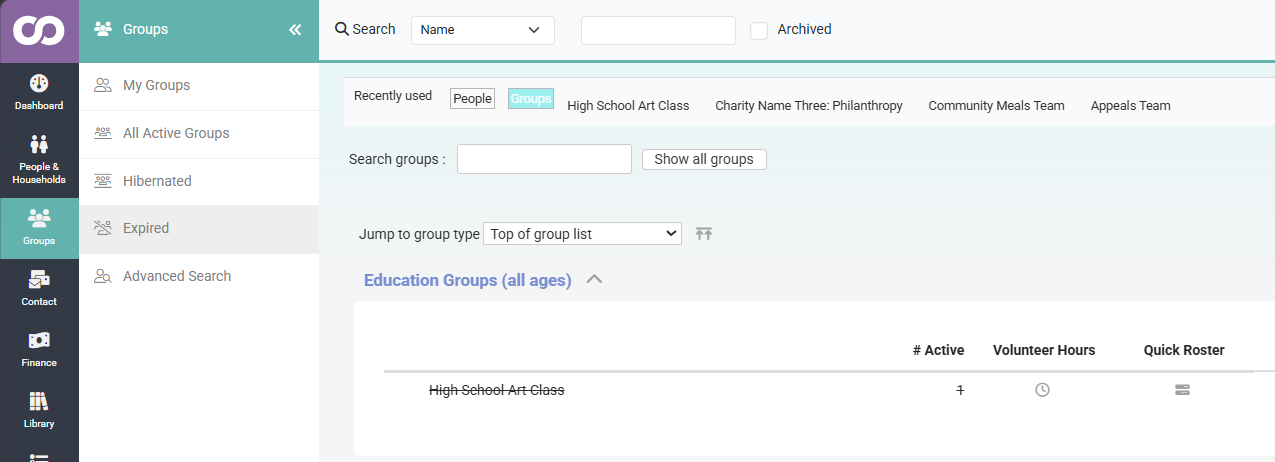
- In the same sidebar, click Expired to see only expired groups. Their names appear with a strike-through.
The sidebar Hibernated and Expired items only appear if you have the Search any group permission. Group Administrators without that permission can still reach their own hibernated or expired groups via the Show all groups button or via My Groups.
Reactivate a group
To bring a hibernated or expired group back, edit it and clear the date (or move the date past today).
- Open the group. Use Show all groups if the group does not appear in the default list.
- Click Edit.
- Clear the Hibernation date, the Expiration date, or both. You can also pick a future date instead of clearing the field, in which case the group is active now and re-enters the state on that future day.
- Click Save.
What happens to members?
Members stay attached to the group through hibernation and expiry. Nothing is removed and no workflow fires from the state change itself.
- Existing memberships remain on each person's profile.
- The group's history (joined dates, left dates, attendance, notes) is preserved.
- The group is read-only while hibernated or expired. The Add members affordance is hidden until the group is reactivated.
- People's individual profiles still show their membership history regardless of the group's state.
What changes between the two states is where the group still shows up:
- Reports. Active-only reports hide both hibernated and expired groups by default. The report builder has an Include hibernated groups criterion that brings hibernated groups back into the result; expired groups stay out. Reports built on explicit "Currently Hibernated", "Currently Expired", or "Currently Hibernated or Expired" status filters can also include them deliberately.
- Contact-list sends (email, text, document). Hibernated groups stay available as a target. Expired groups drop out of the contact-list pick-lists until reactivated.
- Rules and workflows that already reference the group keep working. The state change itself does not trigger anything.
Bulk hibernate or expire from Administration
The bulk control acts on every group on the site. Use it only when you want a site-wide change, and check with the rest of your administrators first.
This screen needs the Update System information permission. Group Administrators who don't hold it will not be able to open it.
For sites that need to pause everything in one go, the Administration area has a bulk control. This is useful when, for example, a site is rolling over a season and wants every group hibernated until the new term starts.
You can find this by going to Administration > Groups. Click the administration cog in the top right hand corner to open the Administration area, then click Group Sync.
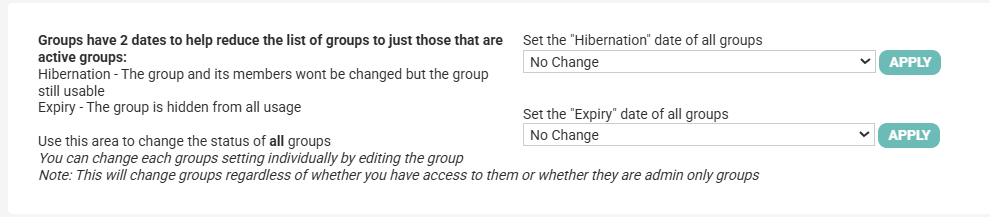
The bulk controls offer three actions for each date. The on-screen labels are:
- No Change leaves the date alone.
- To Yesterday - so all groups are hibernated (or ... so all groups are expired) sets the date to yesterday, hibernating or expiring every group immediately.
- Remove the hibernation date so all groups are active (or the matching expiry option) clears the date on every group, reactivating them.