The recipient list options are the controls that sit around the recipient list on the email compose screen. They do not choose who you are emailing, that is done under Include the following, they shape how infoodle turns your selection into a final send: whether you see the list, whether duplicate addresses are collapsed, whether a household gets one email or several, and whether the email is personalised or copied to everyone at once. This article is the map to those controls. Each one has a short deep dive of its own, linked below.
Before you start
Role Permissions
- Contact people by email: lets you open the email compose screen and work with the recipient list and its options.
- Run reports: only needed when you build your recipient list from a saved report.
See Contact Permissions for what each of these role permissions means and how an administrator turns them on under Settings, Roles.
The options at a glance
Add your people, groups, filtered groups or saved reports under Include the following, then use these controls to shape the send. The table lists each option, what it does, and how it behaves before you change anything.
| Option | What it does | Default |
|---|---|---|
| Recipient List | Shows or hides the Details of people selected preview table so you can check exactly who is on the send. | Off (list hidden) |
| Remove duplicate emails | Collapses contacts who share an email address so that address is emailed once. | On |
| One email per household | Merges the members of a household or organisation into a single recipient. | Off |
| To/BCC | Switches between a personalised email to each person and one non-personalised email copied to everyone. | Off (personalised, one To email each) |
| Exclude | A per-row checkbox in the preview table that drops one contact from this send only. | Unticked (contact included) |
Each option in detail
Recipient List
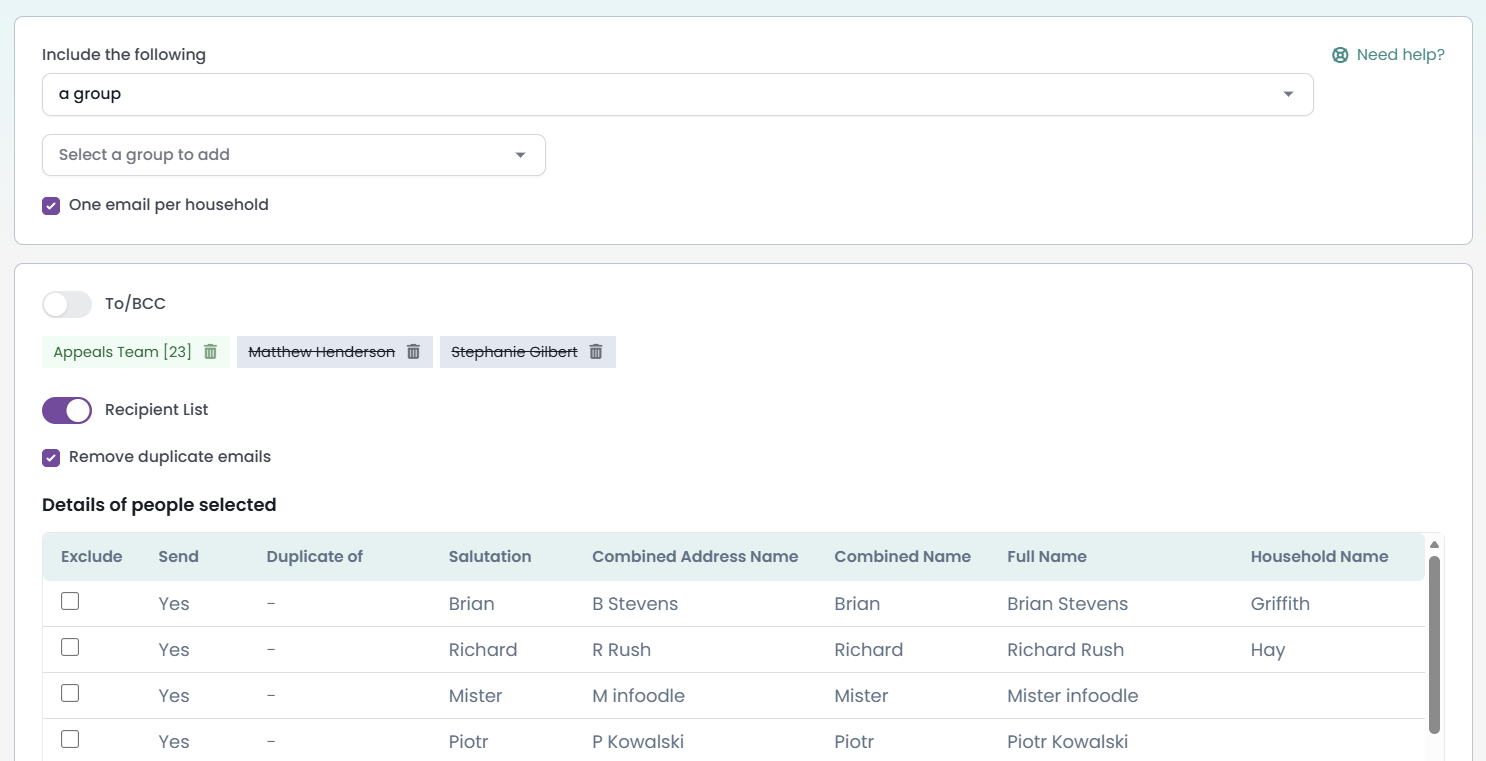
Turn on the Recipient List switch to open the Details of people selected table. Each row shows one contact with their Send status, Salutation, Full Name and Household Name, so you can confirm the list before you write the email. When the list is open, a Show each email address option appears alongside it. Tick it to display each contact's individual email address in the table. Like the Recipient List switch itself, this only changes what you see, it does not change who receives the email. Turning the switch off hides the table again without changing who receives the email. See Recipient List Show or Hide.
Remove duplicate emails
When this is ticked, which is the default, a contact whose email address already appears earlier in the list is marked Duplicate in the Send column, and the Duplicate of column names the contact it matched. That address is then emailed only once. Untick it to email every contact separately, even when they share an address. See Remove Duplicate Emails.
One email per household
When this is ticked, infoodle sends a single email to each household or organisation rather than to every member, and the preview adds Combined Address Name and Combined Name columns to show the merged recipient. This lowers your recipient count. See One Email Per Household/Organisation.
To/BCC
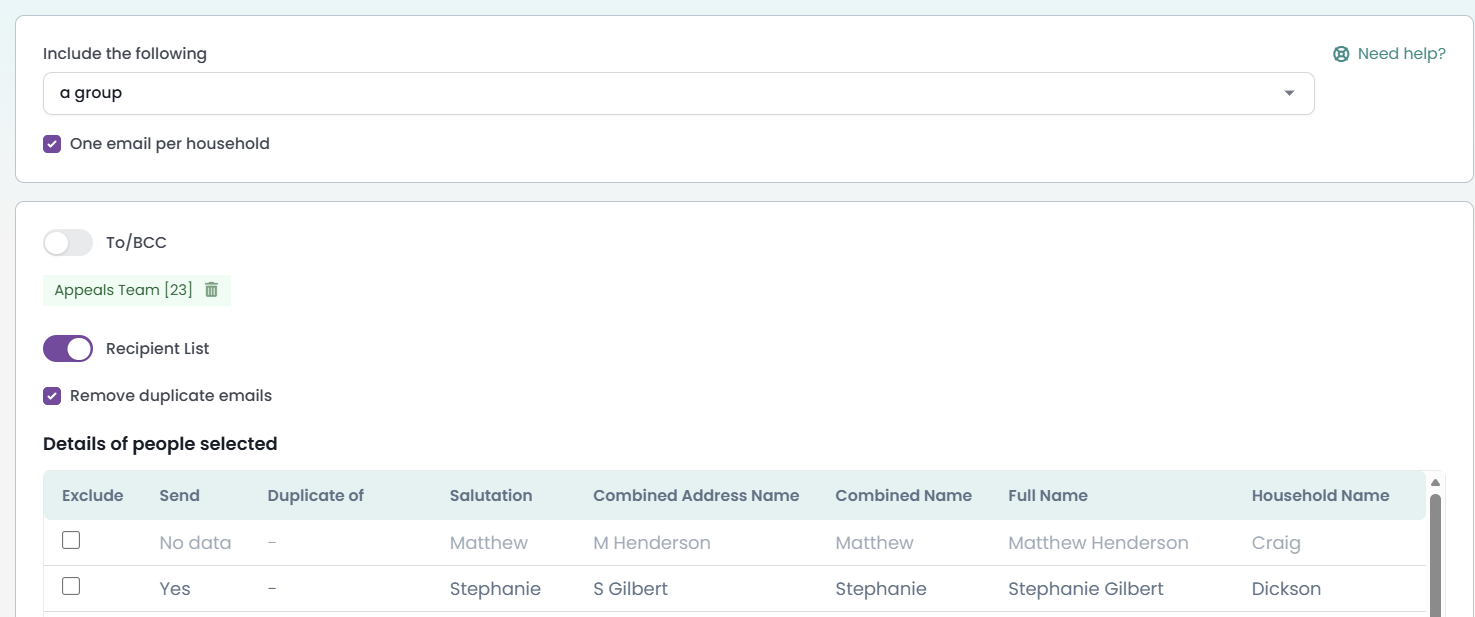
Left off, infoodle sends a separate, personalised email to each recipient, and merge tags like the person's name are filled in individually. Turn it on to send one email copied to everyone as CC or BCC instead, which is useful for a short notice to a small group. You choose To, CC or BCC for each recipient separately: click a recipient's chip in the list and pick To, CC or BCC from the menu that opens. CC recipients can see each other's addresses, BCC recipients cannot. A copied send is limited to a maximum of 50 recipients. See To/BCC and CC.
Exclude
Every row in the preview table has an Exclude checkbox. Tick it to drop that one contact from this send. They move into the Excluded contacts count and stay in the group for next time.
Global unsubscribes are always removed
One rule is not an option you can turn off. A contact who has unsubscribed from all of your emails is always suppressed. They never appear in the recipient list, and the preview shows the note Global unsubscribes are not included below the table. There is no control on the compose screen to email a globally unsubscribed contact, so anyone who has already unsubscribed from all emails is removed for you automatically. This automatic suppression is a separate thing from whether an unsubscribe link is added to the email you send, which is controlled by its own setting on the compose screen.
See Unsubscribe and Email Preferences for how a contact unsubscribes and how an administrator reviews unsubscribe status.
Reading the recipient summary
Below the preview table infoodle shows a running summary that updates as you change the options:
- Excluded contacts: how many rows you have ticked to exclude.
- Email addresses: the number of unique addresses that will actually be emailed. This is the number to trust for your send.
- Total unique contacts: how many contacts are on the list.
The Email addresses figure can be lower than Total unique contacts, because removing duplicates and merging one email per household both reduce the number of addresses without removing people from the list.
Common questions
Which options are on before I change anything?
Remove duplicate emails is on. One email per household and To/BCC are off, and the Recipient List preview is hidden until you turn it on.
Why is my Email addresses count lower than the number of people I added?
Remove duplicate emails collapses shared addresses, One email per household merges household members, and any contact with no active email address or a global unsubscribe is left out. See Who will receive this email for the full set of reasons a contact is included or excluded.
Can I email someone who has unsubscribed from everything?
No. Global unsubscribes are always removed from the recipient list and this cannot be switched off from the compose screen.
Next steps
Set the options to suit your send, turn on the Recipient List to check the final list, then write and send your email. To change who is on the list rather than how they are emailed, add or remove sources under Include the following. See Selecting Email Recipients.